


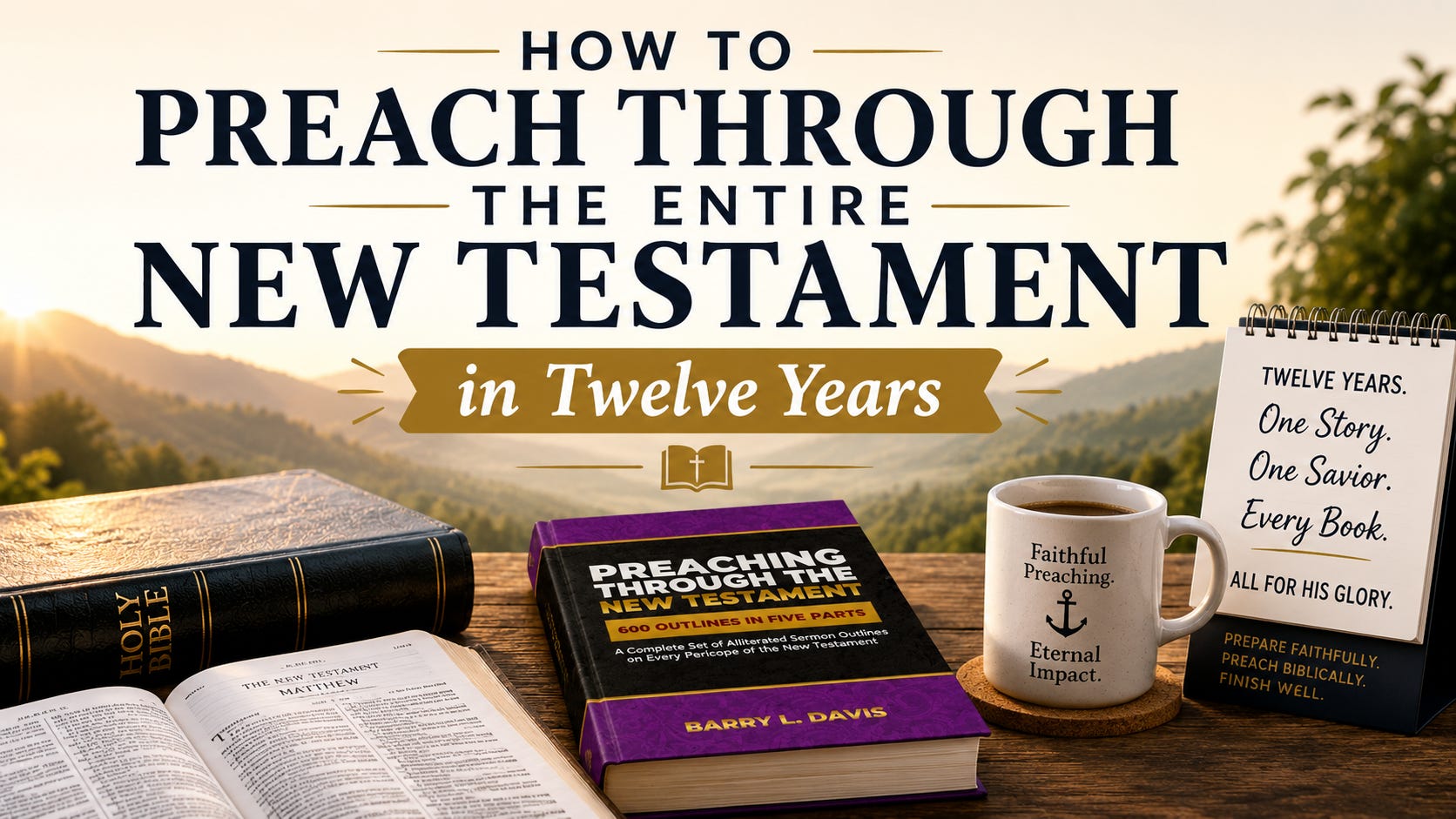
Key Verse:
“For I did not shrink from declaring to you the whole counsel of God." — Acts 20:27
Why Twelve Years?
There are two reasons a working pastor never gets around to preaching through the New Testament systematically. The first is that it sounds impossibly large. The second is that the math, on its face, doesn’t seem to work — between Christmas, Easter, Pentecost, special services, guest preachers, vacation pulpit supply, and the occasional topical series your congregation asks for, you don’t have anything like fifty-two preaching Sundays a year to spend.
Both objections dissolve when you stretch the project out long enough. Twelve years is the sweet spot. It’s long enough that the pace stays sane — roughly forty-five to forty-eight pericopes per year, which leaves four to seven Sundays for special occasions, pulpit guests, vacations, and the inevitable surprises. It’s also short enough to be meaningful: a pastor who starts this plan at forty will finish at fifty-two, having walked his people through the entire apostolic witness during a season of life when they’re old enough to engage it and young enough to remember it. A congregation that hears this kind of preaching for twelve consecutive years is shaped by it in ways that no topical series can match.
The plan below uses my book Preaching Through the New Testament: A Complete Set of Alliterated Sermon Outlines on Every Pericope of the New Testament (GodSpeed Publishing, 2026) as a model — not because you have to use the outlines, but because the book is organized to make exactly this kind of long-arc planning possible. The 600 outlines are divided into five carefully structured parts that map directly onto the natural divisions of the New Testament canon:
Part 1: The Life of Christ — 225 outlines, a harmonized chronological treatment of the four Gospels
Part 2: The Acts of the Apostles — 77 outlines
Part 3: Romans and 1–2 Corinthians — 119 outlines (Paul’s longest letters)
Part 4: Paul’s Shorter Letters — 96 outlines (Galatians through Philemon)
Part 5: Hebrews and the General Epistles, plus Revelation — 83 outlines (Hebrews, James, 1–2 Peter, 1–3 John, Jude, Revelation)
Since the Gospels are harmonized rather than treated separately, the same passage isn’t preached four times. That single decision is what makes the twelve-year plan feasible — without it, the Gospels alone would consume more than five years of Sundays.
The Liturgical Calendar Question
Before laying out the year-by-year schedule, a word about the Christian year. Protestant congregations vary widely on how much of the liturgical calendar they observe. Some keep the full cycle — Advent, Christmas, Epiphany, Lent, Holy Week, Easter, Eastertide, Pentecost, Ordinary Time. Others observe only Christmas Sunday, Easter Sunday, and perhaps Palm Sunday and Pentecost. Still others treat the calendar lightly, observing Christmas and Easter alongside Mother’s Day, Father’s Day, Memorial Day weekend, Independence Day weekend, and Thanksgiving.
The plan below is built to accommodate both ends of that spectrum. Two assumptions:
Minimal-calendar congregations typically reserve four to five Sundays a year for special observance: Christmas Sunday, Easter Sunday, Palm Sunday or Maundy Thursday (if you do a separate Holy Week service), Pentecost Sunday, and perhaps Thanksgiving Sunday. That leaves about forty-seven Sundays a year for systematic preaching.
Full-calendar congregations add Advent (typically four Sundays), Lent (six Sundays plus Holy Week), Ascension Sunday, and Trinity Sunday. That can claim as many as twelve to fifteen Sundays a year, leaving only thirty-seven to forty for the through-the-Testament plan — which would stretch the project to sixteen years rather than twelve.
For the article that follows, I’m assuming the minimal-calendar model. Pastors in full-calendar traditions should simply expect the plan to take longer, or do what many do already: preach the Advent and Lenten Sundays from the book by pulling the appropriate pericopes out of sequence for those seasons, then returning to your sequential reading the following week. That second approach — pulling Christmas and Easter outlines forward, then returning to the main thread — is what makes the calendar fluid rather than rigid, and it’s the approach I’d recommend.
The Twelve-Year Plan at a Glance
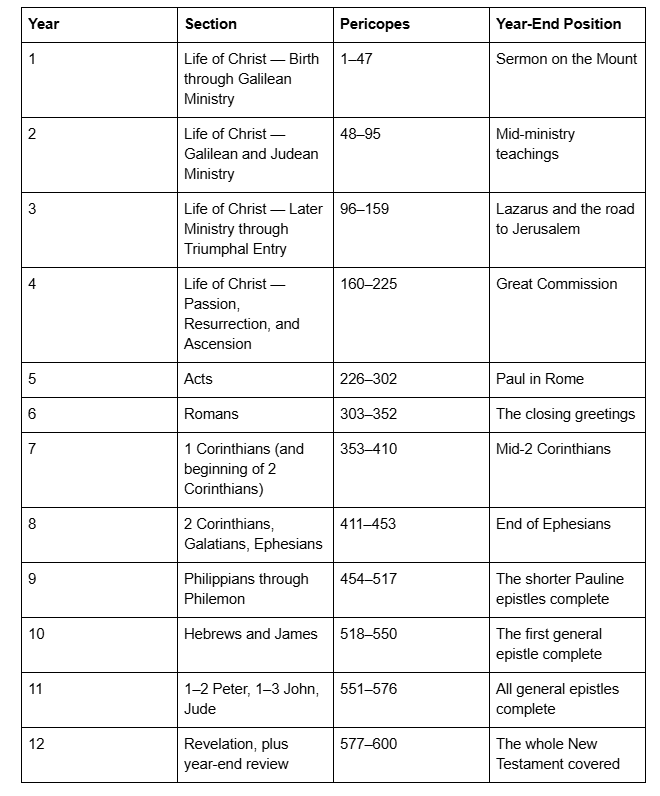
That’s an honest summary of the arc. Year 1 starts in Bethlehem; Year 12 ends with “Behold, I am coming soon.” A pastor and congregation who walk it together have, in twelve years, considered every passage of the New Testament — over six hundred individual sermons, every parable, every miracle, every epistolary argument, every apocalyptic vision. There is no faster way to disciple a people in the whole counsel of God.
How the Christian Year Folds In
Three special occasions — Christmas, Easter, and Pentecost — fall in predictable places in the church calendar, and they need to be handled deliberately rather than pretending the sequential plan can accommodate them.
The good news is that the book’s structure makes this almost automatic. The Christmas pericopes (outlines 8–13: Joseph’s dream through the escape to Egypt) live near the beginning of Part 1. The Easter pericopes (outlines 212–222: from the crucifixion through the resurrection appearances) live near the end of Part 1. Pentecost (outline 228, Acts 2:1–13) opens Part 2.
The recommended approach is what I’d call fluid sequential preaching: you preach through the book in order, but you pull the Christmas, Easter, and Pentecost pericopes out of their place in the queue when those Sundays arrive on the calendar, then resume where you left off. The math still works out to about forty-five sermons of forward progress per year.
Here is how that plays out across each year:
Christmas Sunday uses outlines 9 (“No Room for the King”) or 10 (“Good News on the Hillside”) in early years, or after those run out, you may either repeat your favorite or use the broader nativity passages — Luke 2, Matthew 2, John 1 — from a different angle.
Christmas Eve (if you preach a separate service) typically pairs with outline 8 (“Joseph’s Dream”) or 11 (“Eyes That Saw Salvation”).
Palm Sunday uses outline 160 (“Hosanna!”) — pull it forward whenever you reach the Easter season, regardless of where you are in the sequence.
Good Friday (if you preach it) uses outline 212 (“Father, Forgive Them”) or 213 (“It Is Finished”).
Easter Sunday uses outline 216 (“He Is Not Here”), 217 (“Rabboni!”), or 218 (“All Hail!”). Three Easters in twelve years can be a sermon series on the three resurrection encounters, one per year.
Pentecost Sunday uses outline 228 (“The Coming of the Spirit”) — and after the first preaching of it, outlines 229 and 230 in subsequent years.
Ascension Sunday (the seventh Sunday of Easter) uses outline 225 (“Until I Come Again”) or 226 (“Until He Comes Again,” Acts 1:1–11).
The principle is simple: the calendar drives the special days; the book drives the through-line. When you reach a special Sunday, you pull the appropriate outline from the book, preach it, and resume the next week from where you left off in the sequence. The book is designed so that you’ll work through Christmas and Easter passages in their natural place in the chronological order during Years 1 and 4 — but the years between, you’ll need to pull them out of order, which is exactly what fluid preaching is for.
Year-by-Year Detail
What follows is the year-by-year arc, with notes on how each year fits the calendar, where the natural breaks fall, and what the congregation will be experiencing during that twelve-month stretch.
Year 1 — Bethlehem to the Sermon on the Mount
Pericopes: Approximately #1–47 (47 outlines) Where you finish: The teachings of the Sermon on the Mount
This is a deeply satisfying first year because Christmas falls in its natural place. You begin in January with the prologues of Luke and John, work through the genealogies, the annunciations, the births of John and Jesus, and arrive at the Bethlehem passages just as Advent and Christmas arrive on the calendar. The congregation experiences the unfolding of the nativity story week by week, in the order Scripture records it, and the climactic Christmas Sunday sermon comes as the culmination of months of buildup rather than a one-Sunday observance.
After Christmas you continue with Simeon and Anna, the visit of the wise men, the escape to Egypt, the return to Nazareth, and the boy Jesus in the temple. By Easter you’ve reached John the Baptist’s ministry and the early Galilean ministry of Jesus — exactly the place from which to pull forward Palm Sunday and Easter pericopes. Then you return to the main sequence: the calling of the disciples, the first miracles, the great Sabbath controversies, and finally the Sermon on the Mount, which closes out Year 1.
Year 2 — Galilean and Judean Ministry
Pericopes: Approximately #48–95 (48 outlines) Where you finish: The latter Galilean ministry, just before the Transfiguration
Year 2 is the heart of Jesus’s public teaching. The congregation walks through the major parables of the kingdom (the sower, the wheat and the tares, the mustard seed), the calming of the storm, the Gerasene demoniac, the feeding of the five thousand, the walking on water, and the Bread of Life discourse. This is also the year of the great miracles — the healing of the centurion’s servant, the raising of the widow of Nain’s son, the healing of the woman with the issue of blood, the raising of Jairus’s daughter.
For Christmas in Year 2 you pull forward outline 11 (“Eyes That Saw Salvation”). For Easter, you pull forward outline 217 (“Rabboni!”). Pentecost uses outline 228.
Year 3 — Later Ministry through the Triumphal Entry
Pericopes: Approximately #96–159 (64 outlines) Where you finish: The week before Palm Sunday in the Gospel narrative
Year 3 covers the Transfiguration, the journey to Jerusalem, the seventy disciples, the great parables of grace (the prodigal son, the lost sheep, the lost coin), the rich young ruler, Zacchaeus, and the raising of Lazarus. The pace through this section is brisk; the book treats some material in compact form to leave room for the deeper exposition that the passion narrative requires.
Easter in Year 3 falls just before you reach Palm Sunday in the natural sequence, which is a good year to pull forward outline 218 (“All Hail!”) — the women at the tomb.
Year 4 — Passion, Resurrection, and Ascension
Pericopes: Approximately #160–225 (66 outlines) Where you finish: The Great Commission and the Ascension
This is the year that completes the Life of Christ section. The pacing matters: Palm Sunday falls naturally in early spring at outline 160 (“Hosanna!”), Holy Week falls in its place a few weeks later, Easter Sunday lands almost exactly at outline 216 (“He Is Not Here”) or 217 (“Rabboni!”), and Pentecost Sunday in late spring uses outline 228 — pulled forward by exactly one week from its position in the book.
After Easter, the congregation walks through the resurrection appearances (the road to Emmaus, the upper room, breakfast on the beach, the great commission), and the year closes with Christ’s ascension. This is the natural transition point of the entire twelve-year project: the Gospels are complete, and Acts is ahead.
Year 5 — The Acts of the Apostles
Pericopes: Approximately #226–302 (77 outlines) Where you finish: Paul preaching unhindered in Rome
A full year on Acts is a gift to any congregation. The pace allows real depth on the Pentecost narrative, Peter’s early sermons, the council at Jerusalem, the conversion of Saul, the three missionary journeys, and the long arc of Paul’s imprisonment and journey to Rome. Pentecost Sunday in Year 5 falls almost exactly when the Acts 2 material is being preached, which is the most natural placement in the entire twelve-year plan — no rearrangement needed.
Christmas and Easter in Year 5 require pulling forward Gospel pericopes from Year 1 or 4, which works fine but is the only year where the special-day passages feel like genuine interruptions. Many pastors find this is the best year to preach the same Christmas pericope a second time in twelve years, or to use that Sunday for a topical Christmas sermon outside the book.
Year 6 — Romans
Pericopes: Approximately #303–352 (50 outlines) Where you finish: The closing greetings of Romans 16
Romans deserves a full year. The book outlines fifty pericopes through this epistle, which means you’ll spend extended time on the early chapters about the universal need for the gospel (1–3), the doctrine of justification by faith (3–5), the believer’s sanctification (6–8), Paul’s argument about Israel and the Gentiles (9–11), and the practical exhortations of the closing chapters (12–16). A congregation that hears Romans preached pericope by pericope over an entire year is being doctrinally formed in a way that almost nothing else accomplishes.
Year 7 — 1 Corinthians (and into 2 Corinthians)
Pericopes: Approximately #353–410 (58 outlines) Where you finish: Mid-2 Corinthians, around the discussion of generosity
1 Corinthians is preached in forty-five outlines, which is unusually generous for a Pauline epistle. The reason is that the issues Paul addresses in 1 Corinthians — divisions, sexual immorality, the Lord’s Supper, spiritual gifts, the resurrection — are uniquely well-suited to the working life of a contemporary congregation. The pastor who walks his people through 1 Corinthians has done a year of practical ethics, ecclesiology, and resurrection theology in one stroke.
You’ll spill over into the early chapters of 2 Corinthians at the end of the year, which is a natural and gentle transition.
Year 8 — 2 Corinthians, Galatians, and Ephesians
Pericopes: Approximately #411–453 (43 outlines) Where you finish: The end of Ephesians and the armor of God
This is a year of major Pauline letters in succession: the rest of 2 Corinthians (Paul’s defense of his ministry), all of Galatians (justification by faith, the freedom of the Christian), and all of Ephesians (the church as the body of Christ, the household codes, the armor of God). It’s a doctrinally dense year and a pastorally rich one. Galatians especially functions as a useful contrast to the practical concerns of 1 Corinthians the year before.
Year 9 — Philippians through Philemon
Pericopes: Approximately #454–517 (64 outlines) Where you finish: The end of Philemon
This year completes the Pauline corpus apart from Hebrews. The congregation hears Philippians (joy in adversity), Colossians (the supremacy of Christ), 1 and 2 Thessalonians (the return of Christ), the Pastoral Epistles (church order and faithful ministry), Titus (sound doctrine), and Philemon (the gospel applied to a personal relationship). Sixty-four pericopes in a year is a brisker pace than some earlier years, but the shorter epistles allow it: each letter receives focused, weeks-long attention without the pace ever feeling forced.
Year 10 — Hebrews and James
Pericopes: Approximately #518–550 (33 outlines) Where you finish: The end of James, with the call to prayer for the sick
Hebrews and James together make a satisfying year. Hebrews provides the theological framework — the supremacy of Christ over the angels, over Moses, over the Levitical priesthood, the better covenant, the great cloud of witnesses, the discipline of the Lord. James grounds it in practical ethics — trials, the tongue, faith and works, prayer, patience. The contrast is intentional in canon, and it preaches beautifully.
Year 11 — 1–2 Peter, 1–3 John, and Jude
Pericopes: Approximately #551–576 (26 outlines) Where you finish: The doxology that closes Jude
This is a slower year — twenty-six pericopes — which leaves room for a topical mini-series or two during the year if your congregation has been asking for one. The General Epistles offer rich material on suffering and hope (1 Peter), the dangers of false teaching (2 Peter, Jude), and the heart of the Christian life as love (1–3 John). Year 11 functions as a kind of breathing space before the climactic Year 12 ahead.
Year 12 — Revelation
Pericopes: Approximately #577–600 (24 outlines) Where you finish: “Behold, I am coming soon” — the closing words of the New Testament
Twenty-four outlines on Revelation gives you the space to handle the book responsibly without either rushing through the visions or losing the congregation in speculative detail. The pastor who has spent eleven years preparing his people for this year — building the doctrinal vocabulary, the typological imagination, the theological framework — will find his congregation able to receive Revelation in a way that most American Protestants never have the chance to.
The final outline of the book, #600 (“Revelation 22:6–21 — Behold, I Am Coming Soon”), is a natural fit for the last preaching Sunday of the twelfth year. The closing benediction is fitting both for the New Testament and for a twelve-year preaching project drawing to a close.
Three Practical Notes
On pacing. The plan assumes about forty-five to forty-eight sermons of forward progress per year. In any given year, you may actually preach more or fewer pericopes depending on how special occasions land, how many Sundays you have a guest preacher, and whether any particular passage warrants two Sundays rather than one. The book is designed to absorb that variability — none of the outlines build sequentially in a way that breaks if you take a side trip. You can pause, go topical for a month, and resume without losing the thread.
On flexibility. Nothing about the twelve-year arc is sacred. Some pastors will find Romans warrants two years rather than one; others will find that Acts at one outline per week is too slow and they want to compress. Pastors who want to spend extra time on the Acts of the Apostles can give it eighteen months and stretch the whole plan to thirteen years; full-calendar Anglican-leaning pastors can spread the same content across fifteen years. The principle matters more than the precise arithmetic.
On preaching beyond the outlines. The 600 outlines in Preaching Through the New Testament are starting points, not finished sermons. Each one provides an alliterated three-to-five-point structure with sub-points and Scripture citations, but the prayerful work of developing the manuscript, choosing illustrations, applying the text to your particular congregation, and shaping the sermon for delivery is yours alone. The book is meant to remove the friction of starting from scratch every Monday morning — to give you a structured way into the text — not to replace the pastoral work that comes after.
A pastor who commits to this plan — even loosely, even imperfectly — gives his congregation something rare and precious: the whole apostolic witness, preached in order, over a stretch of years long enough that the Word genuinely shapes them. Twelve years from now, you and your people will look back at having walked the full road from Bethlehem to “Behold, I am coming soon.” There is no preaching project I can recommend more highly.
Barry L. Davis is the author of Preaching Through the New Testament: A Complete Set of Alliterated Sermon Outlines on Every Pericope of the New Testament (GodSpeed Publishing, 2026), along with the companion volumes 500 Three-Point Alliterated Sermon Outlines and 300 Five-Point Alliterated Sermon Outlines. All three are available on Amazon in paperback and Kindle editions.

"Unless otherwise noted, Scripture quotations taken from The Holy Bible, New International Version®, NIV® Copyright © 1973, 1978, 1984, 2011 by Biblica, Inc.™ Used by permission. All rights reserved worldwide."
Is the calendar above in the book
Dear Pastor sorry if i seem rude. But it’s my real basic question. Does Jesus ever promise wealth or prosper on Earth? All i know He ask Apostles to leave everything to follow Him? Any time Jesus teach Us about prosperity in Earth? Lately the more and more i learn bible, i get that God’s teach us happiness by believing in eternal life? Is it true? Furthermore fyi.. I only have faith on GOSPEL (Gods Word) for the rest i cannot accept that it’s not directly God’s Word? Since lifting to heaven? Can you please guide me?