


Key Verse:
“They read from the Book of the Law of God, making it clear and giving the meaning so that the people understood what was being read.” (Nehemiah 8:8) (all scripture is from the NIV)
It’s Saturday Night Again
Every pastor knows the feeling. The week was full of hospital visits, a board meeting that ran long, a funeral nobody saw coming, and a dozen conversations that mattered more than any sermon. Now it is Saturday night, the house is quiet, and the text for tomorrow is still sitting open on the desk.
You have notes. You have commentaries. You have three good illustrations and a half-finished outline. What you don’t have is a clear path from the text to the people who will be sitting in front of you in fourteen hours.
The problem usually isn’t that we have too little to say. It’s that we have too much, and we haven’t yet decided what matters most.
Ezra Gave the Meaning
When Ezra stood on the wooden platform in Nehemiah 8, he wasn’t trying to impress anyone. He read the Law, and the Levites helped the people understand it. They made it clear and gave the meaning. Men, women, and everyone old enough to understand stood from early morning until midday and listened.
That is still the work. Not to say everything that could be said about a passage, but to make plain what God is saying through it. A sermon serves the people best when it has one clear point, a few faithful movements, and a call to respond.
Length Is Not the Same as Depth
Some of the most memorable sermons you ever heard could have been outlined on a napkin. The preacher knew where he was going, and so did you. Some of the most forgettable could fill a notebook.
Depth comes from staying with the text long enough to see what it is actually saying. Clutter comes from refusing to leave anything out. Most of us have preached both kinds of sermons, and our people could tell the difference before we could.
If you can’t state your sermon’s big idea in one sentence, your congregation won’t be able to either.
The Pastor Who Cut Two Points
Picture a pastor in a small church who has five points planned on the Prodigal Son. Saturday gets away from him, and he walks into the pulpit with only three.
At the door, a man who rarely speaks stops to shake his hand. “I’ve been coming here eleven years,” he says. “That’s the first sermon I could tell my wife about at lunch.”
The two points he cut were good points. They just weren’t the point.
Let the Text Set the Shape
A clear outline isn’t a formula pressed onto every passage. It is the shape of the text made visible. A psalm of lament moves differently than a parable. A doxology in Romans moves differently than a narrative in Acts.
The question isn’t, “How do I get three points out of this?” It’s, “What is this passage doing, and how can I help my people see it?” When the outline follows the text, the sermon carries the text’s authority instead of the preacher’s cleverness.
Every Sermon Should Lead Somewhere
Explanation without application leaves people informed but unchanged. Application without explanation leaves them motivated but unanchored. The sermons that change lives do both, and then they open the door.
Every text, in one way or another, brings us to Jesus. Somewhere in every sermon there is a sinner who needs to hear that he can be forgiven, and a believer who needs to hear that she can come home again. Don’t send them out without saying so plainly.
Preparation Is Not Plagiarism
Some pastors feel guilty using any outside help. But no preacher studies alone. We lean on commentaries, lexicons, old sermons we heard as young men, and the wisdom of saints who went before us.
A good resource doesn’t replace your study; it gives it a head start. It hands you a clear structure so you can spend your limited hours on prayer, on the text, and on the people you know by name. The sermon still has to pass through your own heart before it reaches theirs.
One Sheet. One Sermon.
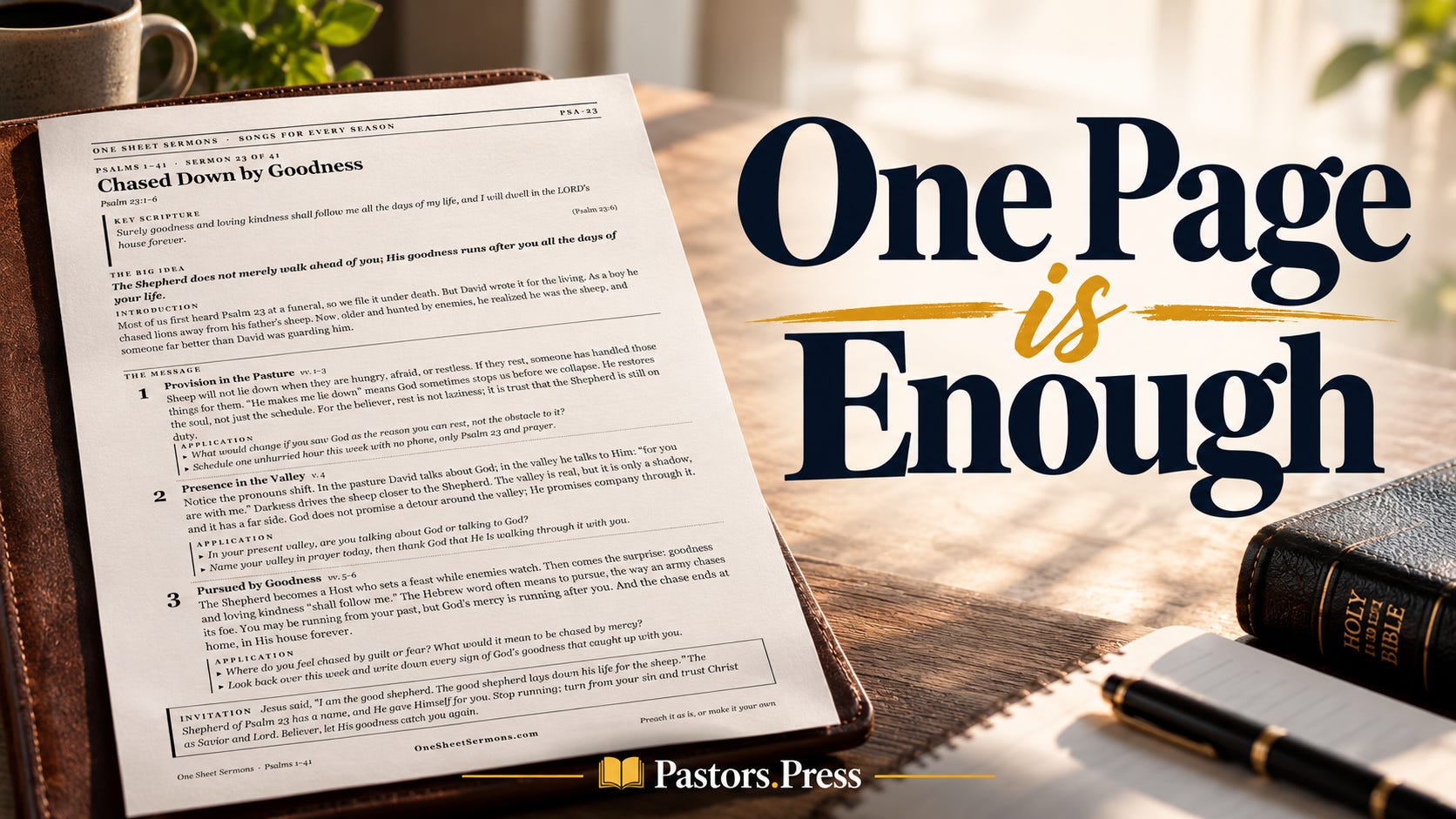
That conviction is behind a new resource I’ve been building: One Sheet Sermons.
Each sermon fits on a single 8.5×11 page. Every sheet has the same simple, preachable structure:
Key Scripture, quoted from the Word of God
The Big Idea, one sentence your people can carry home
An introduction that opens the sermon rather than summarizing it
Three alliterated points, each with explanation and two concrete applications
An invitation that grows out of the text and calls hearers to repent and trust Christ as Savior and Lord

The library holds 812 sermons in 51 series: every book of the New Testament, all 150 Psalms, Proverbs, Christ in the Old Testament, the Life of Joseph, Advent Prophecies, 28 sermons for holidays and special occasions, and 20 short topical series on subjects like the home, forgiveness, money, prayer, and hard seasons of life.
Every series comes as an editable Word file with a cover page, a PDF preview, and each sermon as its own Word file. Preach it as is, or make it your own. It’s a starting point, not a script.
Series start at $5, and the Complete Library is available for $149.
Browse the library at OneSheetSermons.com
A Final Word
Pastor, your people don’t need everything you know about the text. They need the one thing God is saying through it, said plainly, and a clear way to respond.
Study deeply. Pray honestly. Then cut what doesn’t serve the point. Make it clear and give the meaning, so that they understand what is being read.
One page is often enough.
Keep preaching the Word.