


Key Verses:
““And he said to them, ‘Pay attention to what you hear…’ —Mark 4:24a (ESV)“Therefore we must pay much closer attention to what we have heard, lest we drift away from it.” —Hebrews 2:1 (ESV)
Something has changed in the pew.
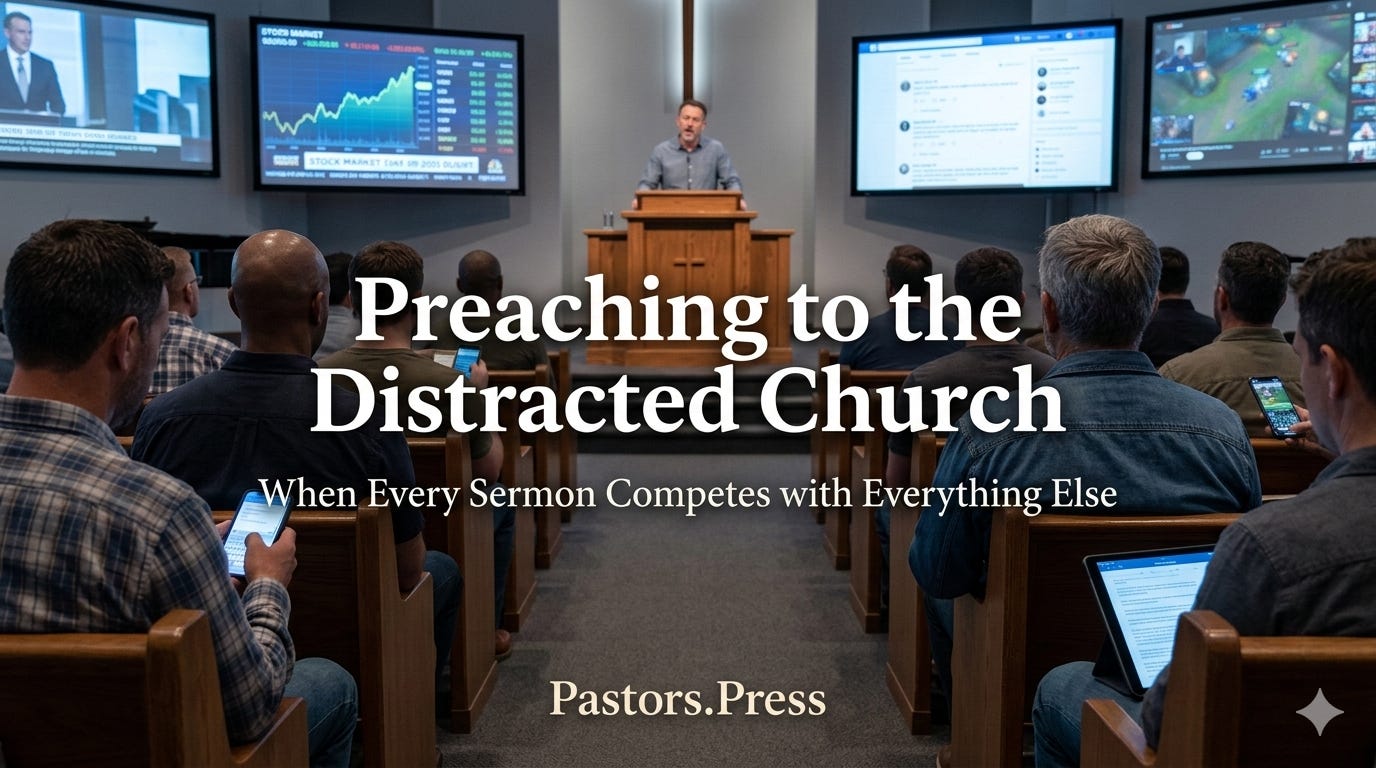
It is not that people no longer believe in God. It is not that they have stopped coming to church. It is that many of them are here in body but somewhere else entirely in mind. The sermon has not even reached its first point before a phone has been checked, a thought has wandered, and the moment has slipped away.
The data is sobering. The average American checks their smartphone 144 times per day—roughly once every six and a half waking minutes (Reviews.org, 2024). Research from Microsoft found that the average human attention span has dropped to approximately eight seconds, down from twelve seconds in 2000. Social media platforms are engineered by teams of behavioral psychologists whose singular goal is to make sustained focus feel unnatural. And it is working.
Pastors are preaching into the teeth of the most distracted culture in human history.
The temptation is to respond by shortening sermons, adding more video clips, and making Sunday morning feel like a TED Talk. But this is not a production problem. It is a spiritual one. And the solution is not found in entertainment—it is found in the ancient, Spirit-empowered art of preaching that forms the soul as well as informs the mind.
The church does not need to outperform Netflix. It needs to out-nourish it.
Why Distraction Is a Discipleship Crisis
1. Distraction Is Not Neutral—It Is Formative
Every pastor knows that people are distracted. Fewer recognize how deeply distraction reshapes the soul. Philosopher James K. A. Smith has argued persuasively that we are shaped not just by what we think but by what we repeatedly do and attend to. Habitual distraction trains the mind to resist depth. It conditions people to expect constant novelty, immediate gratification, and frictionless experience.
When someone sits in your sanctuary having spent the previous week in fragmented, scroll-driven, dopamine-loop media, they are not merely inattentive. They have been formed—by liturgies of distraction—to be incapable of sustained attention. The congregation’s struggle to focus is not laziness. It is spiritual formation working in the wrong direction.
This is why the stakes are so high. A church that does not address the attention crisis is not merely dealing with a communication preference. It is watching its people be discipled by a rival—and deeply corrosive—liturgy.
2. Distraction Is Eroding Scripture’s Hold on the Heart
The Barna Group’s 2022 State of the Bible report found that only 11 percent of Americans read the Bible daily, down from 14 percent in 2021. Bible engagement among practicing Christians has declined measurably over the same period that smartphone ownership has climbed. These trends are not coincidental.
Scripture requires something that digital culture actively dismantles: sustained, receptive attention. The Psalms were written to be meditated on. The epistles were written to be read aloud in full to a gathered assembly. The Gospels unfold as extended narratives designed to form the imagination over time. None of this works in three-second increments.
Hebrews warns us: “We must pay much closer attention to what we have heard, lest we drift away from it” (2:1). Drifting is the natural result of distraction. The writer is not addressing careless people. He is addressing human beings who, without intentional effort, will allow truth to seep out of their souls like water through a leaky vessel.
The sermon is one of the primary means by which God’s Word takes up residence in human hearts. If pastors lose the congregation’s attention, they lose one of the church’s most powerful tools for spiritual formation.
3. Distraction Is Damaging More Than Attention Spans
The mental health implications are staggering. The American Psychological Association’s 2023 Stress in America survey found that 35 percent of adults report that their smartphone use makes it hard to concentrate when they want to focus on important things. A study published in the Journal of Social and Clinical Psychology linked social media use directly to increased depression and loneliness.
Pastors are not merely competing for attention. They are preaching to people who are mentally exhausted, emotionally fragmented, and spiritually depleted—in part because of the very devices they carry into the sanctuary.
This means the distracted congregation is not a strategic problem to be solved. It is a pastoral problem to be met with understanding, wisdom, and a deeper dependence on the Holy Spirit to do what no preaching technique can accomplish.
What Attention-Worthy Preaching Looks Like
The answer to distraction is not a shorter sermon. It is a better one. Here is what preaching that recaptures attention looks like:
Begin with the human question, not the biblical text. Distracted people do not engage because they do not yet feel the relevance of what is coming. Begin with the ache, the struggle, the question that your text answers. Make them feel the need before you offer the supply. Jesus did not open the Sermon on the Mount with a thesis statement. He began with Beatitudes that named the experience of the people sitting before Him.
Preach to the imagination, not just the intellect. The mind can wander even while the intellect is engaged. The imagination, once captured, holds attention with a grip that logic cannot match. Use narrative. Use concrete images. Use stories that function like windows, allowing people to see the truth from the inside rather than simply being told it from the outside. Fred Craddock was right: the ear follows what the eye can almost see.
Create tension and move toward resolution. Effective preaching is structured like a good story: something is wrong, the wrongness deepens, and then grace arrives. Listeners will stay engaged as long as the resolution has not yet come. Sermons that resolve every tension too early give the congregation permission to mentally check out. Hold the tension long enough to let the Gospel’s arrival feel like relief.
Vary your pace, tone, and register. A monotone delivery is not merely a stylistic weakness—it is an invitation to wander. The human brain attends to contrast and change. Speed up. Slow down. Whisper. Let silence breathe. Move from the expository to the narrative to the applicational and back again. The congregation’s attention is not lost once—it is lost and recaptured dozens of times in a single message.
Make the application specific and concrete. Vague applications do not engage. “Pray more” produces glazed eyes. “This week, before your feet hit the floor in the morning, speak these words aloud…” produces leaning forward. The more specific the challenge, the more the listener feels personally addressed—and the more attention they pay.
Building a Congregation of Attentive Listeners
The sermon alone cannot solve the attention crisis. Pastoral leadership must address the broader culture of distraction both inside and outside the sanctuary.
Name the Problem from the Pulpit. Distraction will not be addressed if it is never acknowledged. Pastors who speak honestly about the war for attention—and who frame it as a spiritual issue rather than a generational one—give their congregations both language and permission to take it seriously. Preach occasionally on attention itself. Exposition of Psalm 46:10, Mark 4, or Hebrews 2 can open powerful conversations about what it means to be truly present with God.
Create a Culture of Device-Free Worship. This is not a moralistic rule—it is a pastoral gift. Many congregants would welcome the permission to leave their phones in their pockets if the church made it a shared practice rather than a personal discipline. Some churches have seen meaningful engagement increase simply by making a gentle, grace-filled announcement each week: “We invite you to give this hour completely to God. Your phone will wait. He has been waiting all week.”
Incorporate Scripture Reading as a Congregational Practice. Before the sermon begins, slow down. Read the text slowly, deliberately, more than once. Ask the congregation to read it aloud together. This simple liturgical act does something that no technique can replicate: it orients the heart and mind toward the Word before the exposition begins. It is harder to drift when you have already spoken the text with your own lips.
Disciple People in the Practice of Listening. Consider brief teachings—in new members’ classes, small groups, or midweek studies—on how to listen to a sermon. This sounds unnecessary until you realize that most church members have never been taught. What to bring. How to take notes. How to pray during the message. How to review it afterward. Attentive listeners are not born—they are formed.
Follow the Sermon with Reflection, Not Entertainment. What follows the sermon matters as much as the sermon itself. A rushed transition into announcements, upbeat transition music, or immediate dismissal trains the congregation to treat the Word as one item on a program rather than the transformative encounter it is. Build in moments—however brief—of silence, response, or corporate prayer that honor what has just been proclaimed.
The Long View of Preaching in a Distracted Age
The congregation sitting before you this Sunday has spent more hours this week being formed by screens than by Scripture. They have consumed more content in the past seven days than a previous generation consumed in a year. They are not shallow people. They are overstimulated ones.
They need what only the preaching of the Word can give: depth. Weight. The sense that what is being said has eternal consequence. The conviction that the voice speaking is, in some mysterious way, not only a pastor’s but a prophetic one.
The goal is not to compete with the algorithm. The goal is to offer something the algorithm cannot—truth that transforms, grace that heals, a Word that does not return void.
Isaiah did not write for scrollers. Paul did not preach for passive audiences. Jesus did not tell parables to entertain. They preached with the assumption that the Spirit of God would take the proclaimed Word and do what no attention span study, engagement metric, or production value could accomplish.
Preach that way. Trust the Spirit that way. And do not despair when the battle for attention feels like it cannot be won.
It can. It has been won before. And the same Spirit who moved over the waters at creation can move over the fragmented, distracted, weary hearts in your pews this Sunday—and bring light.
Prayer Thought
Lord, we confess that we live in a world engineered for distraction and that even we who preach are not immune to its pull. Give us the discipline to prepare well, the dependence to rely not on technique but on Your Spirit, and the faith to trust that Your Word will accomplish what You intend. When we stand to preach, silence the noise in the room—and in us. May the message that goes forth this Sunday find fertile, attentive soil in the hearts of those who hear it. And may the ears You have given them be tuned, above all the noise of this age, to the sound of Your voice. Amen.
Pastoring Tip
This week, before you finalize your sermon, ask one question about every major section: “Why would a distracted person keep listening here?” If you cannot answer it, revise. The goal is not to dumb down the message—it is to ensure that every movement in your sermon earns the next minute of attention. Preachers who ask this question consistently do not produce shorter sermons. They produce tighter, more urgent, more alive ones. Give your congregation a reason to stay with you—not because the lights are impressive, but because the truth is.
Looking for Preaching Ideas that will grab attention?
CLICK HERE —>: 500 Three-Point Alliterated Sermon Outlines

Very, very insightful... Whew!
May the Lord be merciful... and he will be!